
Cabling and Bracing In Big Sky
Strong trees, safe property, backed by Big Sky's own family team.
How High-Elevation Weather Turns Structural Weakness Into a Real Hazard
Lone Mountain rises sharply above Big Sky Resort, and the snowpack it generates doesn’t stay on the slopes. Heavy, wet snow slides into the tree canopy across Meadow Village and Mountain Village, loading branches and stem unions in ways most trees simply weren’t built to handle. Cabling and Bracing addresses conditions that don’t exist at lower elevations, where snowfall is lighter and growing seasons are long enough for trees to develop stronger wood structure.
Mature conifers at this elevation grow slowly, which limits how much structural reinforcement develops naturally in codominant stems and overextended limbs. When two stems share a weak union, a single heavy snow event can split them apart. Ice and snow damage doesn’t always look dramatic from outside. A crack forming deep in a V-crotch can go unnoticed until the stem gives way.
If you’ve walked around your cabin after a major storm and noticed a large limb hanging lower than before, that’s not settling. That’s structural weakness revealing itself under load. Tree failure risk at this elevation is real, and it compounds with every storm cycle.
Tree cabling and bracing installed to the correct standards transfers the mechanical load away from compromised unions, giving mature trees a genuine path to long-term structural stability rather than eventual removal.
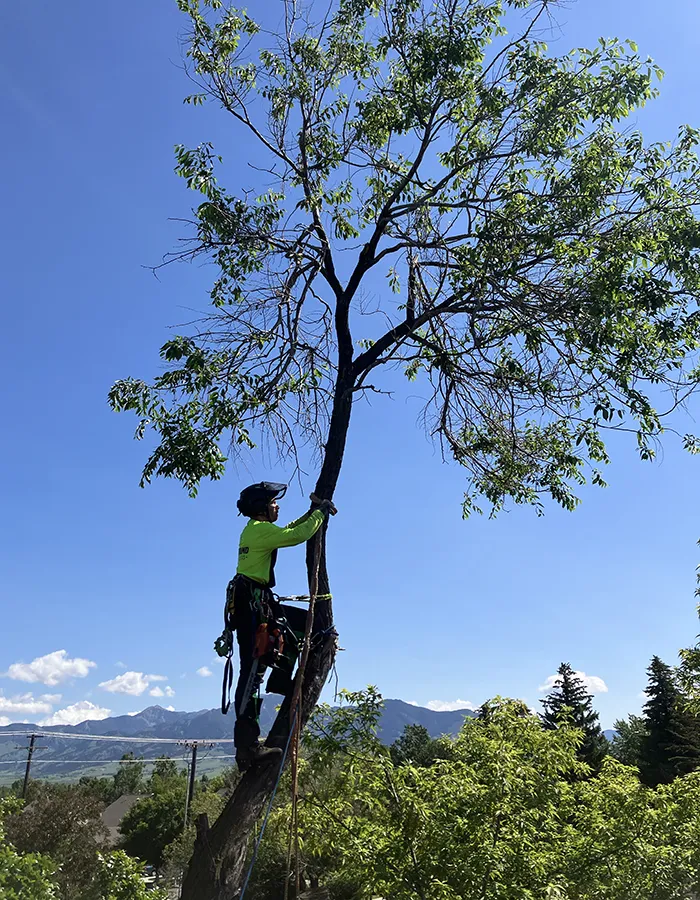
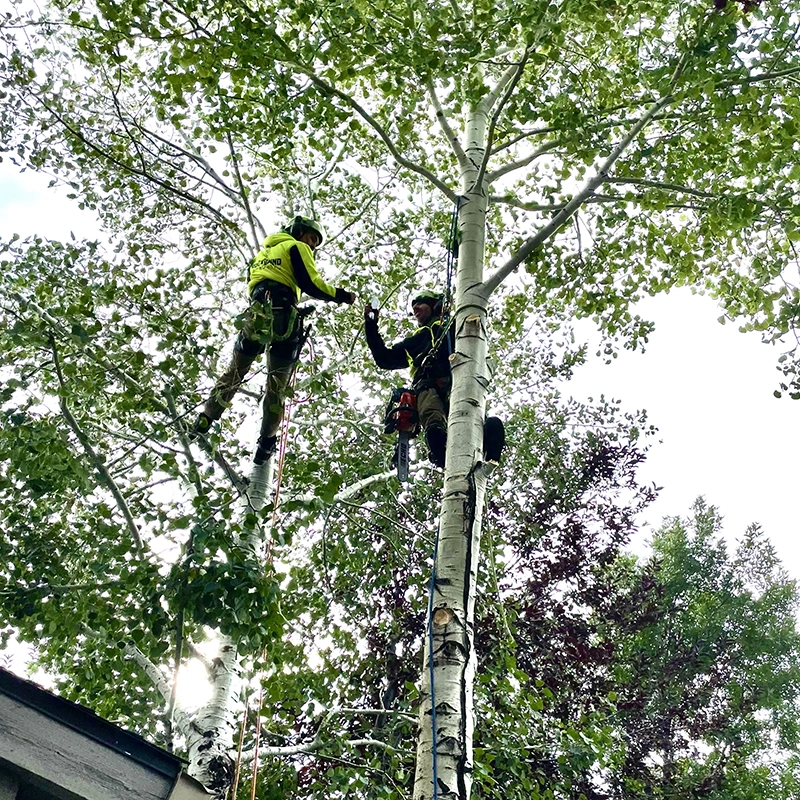
A Cracked Limb Over Your Deck Isn't Just a Tree Problem
You’re walking the property after a wind event near the Big Sky Resort base area, and you notice it – a split trunk on the large conifer hanging over the deck, leaning slightly toward the roofline. Guests check in tomorrow. You have to make a call.
That split is likely a V-crotch, where two stems of equal size compete for dominance and create included bark at the joint. Included bark is compressed, never properly fused, and it fails under load. A leaning tree with that structural defect isn’t a cosmetic issue. It’s a liability.
If a limb or stem comes down on a guest or damages a structure, you’re looking at injury claims, property damage costs, and the kind of emergency tree services that run significantly higher than proactive tree support installation would have. Waiting costs you more every time.
High-value trees with structural defects can often be saved. Cabling and bracing address the problem at the source – steel cables and brace rods redistribute load away from weak unions before they fail. That’s the concrete difference between a secured tree and an emergency call.
Ignoring structural weaknesses doesn’t make them smaller. It just means the next wind event decides the outcome for you.
Frequently Asked Questions
Will cabling and bracing save my tree?
Cabling is not always the smarter alternative to tree removal. That assumption leads property owners to invest in structural support for trees that are already past the point where hardware can help. High-strength steel cables and brace rods are genuinely effective tools – but only when a proper tree structure evaluation confirms the tree is worth saving and safe to retain.
Proper standards exist specifically to draw that line. They guide how a Tree Risk Assessment is conducted, what qualifies a tree as a viable candidate for cabling, and when root instability or advanced tree decay disqualifies structural intervention entirely. Along the Gallatin River corridor, mature cottonwoods with compromised root systems are a common example where cabling looks appealing, but removal is the honest answer.
If you’re weighing cabling cost against tree removal cost, the hardware isn’t the deciding factor. Weak branches or a split trunk with significant decay behind it can fail even with cables installed. What determines the right path is the condition of the tree itself, evaluated against clear standards.
A thorough assessment tells you what the tree actually needs – not what’s easiest to sell you.
What Does TRAQ certification mean when a tree is next to my building?
TRAQ stands for Tree Risk Assessment Qualification, and it is a different credential than a standard ISA Certified Arborist certification. An ISA certification confirms deep knowledge of tree biology, tree health assessment, and proper care practices. TRAQ goes further by qualifying an arborist to conduct formal, standardized risk evaluations that produce documented, defensible records.
That distinction matters if a weak limb over a structure ever becomes a legal question. You may need more than a verbal opinion. You may need written documentation showing that a qualified professional evaluated the tree, identified the structural defect, and recommended a specific course of action.
A TRAQ-qualified assessment covers multi-stem trees, codominant stems, guying trees on unstable terrain, and any situation where tree support systems are being considered near a building. The findings are recorded using a standardized framework, which means the recommendation for cabling and bracing is traceable and justified.
Family-owned and working in Big Sky for eleven years, Rootbound Arborists has built its tree service arborist consultation process around this level of documentation. A cable and brace inspection means nothing if there is no record of why it was installed. TRAQ is how that record gets made.
What Happens When You Schedule a Cabling Assessment With Rootbound?
The visit starts with a full tree structure evaluation. An arborist walks the tree from the base up, checking for codominant stems, included bark, overextended limbs, and any decay that changes the risk picture. If you’re managing a property along a river corridor, that assessment includes root instability from saturated riparian soil.
From there, hardware selection is specific to the tree. Dynamic rope systems work differently than synthetic rope cable systems, and cable tension requirements vary depending on limb weight, crown spread, and how the tree is loaded. The wrong setup creates a false sense of security.
If structural pruning or crown reduction is needed alongside a tree limb support cable, that work is scoped during the same visit. You leave with a coordinated plan, not a single fix applied in isolation.
If you’re a seasonal property owner who won’t be on-site year-round, this matters. The care plan includes annual inspection scheduling, hardware inspection timelines, and any plant health care or tree health care programs that keep the tree stable between visits.
Assessing a structurally compromised tree before it becomes an emergency is always the lower-cost path. A single site visit can tell you exactly where that tree stands and what it needs.